Hi, I'm Sacha.
I am the co-founder of retab, a company that helps make people's work more meaningful by automating boring and mundane tasks with AI. We've raised $3M with VF, K5 Global, StemAI, and are backed by the founders of Datadog, Dataiku and Free.
Our flagship product helps companies build, test and deploy custom document processing pipelines in minutes.
Artificial Intelligence
Retab is an AI product for building end-to-end document workflows that turn unstructured inputs (PDFs, emails, scans) into reliable, production-ready outputs. It combines schema-driven extraction, AI-powered editing, intelligent matching, and automated validation to deliver accuracy and robustness in real-world document workflows.
Research
I love physics, computer science and biology. During my PhD at Collège de France, I studied how embryos self-organize using principles from statistical physics and soft matter. I developed computational tools to reconstruct cellular forces and understand morphogenesis.
My PhD was supervised by Hervé Turlier , research director at the CNRS.
Abstract
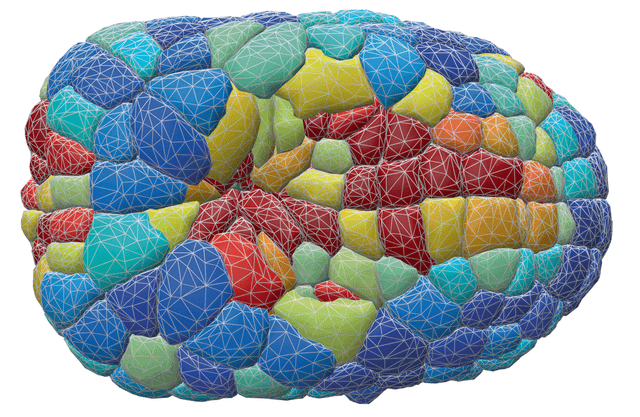
Novel microscopy paradigms have given rise to an abundance of data, both in two and three dimensions, with an unprecedented spatial and temporal resolution. A quantitative comprehension of the mechanical phenomena shaping cells and embryos requires to fit information obtained from these images to physical models, a task referred to as solving an “Inverse problem”. This is the central focus of this thesis. In the initial part, we establish an analogy between early embryos and heterogeneous foams. We delve into the complexities of foam simulation, inferring surface tensions and pressures from images in two ways, first by minimizing the mean-square error of physical equations, then using a more sophisticated optimization procedure in which gradients are calculated with the adjoint-state method. Subsequently, we introduce another tool for microscopy image analysis: alphaMic, an artificial microscope, that generates 3D images from numerical models. This novel tool provides the capability to benchmark algorithms, produce artificial data to train deep-neural networks. Its differentiable version, deltaMic, is able to fit geometry and point spread function models from real microscopy images. Ultimately, we present a method based on optimal transport for inferring membrane flows from kymographs.
Papers
Differentiable Rendering for fluorescence microscopy
Highlights
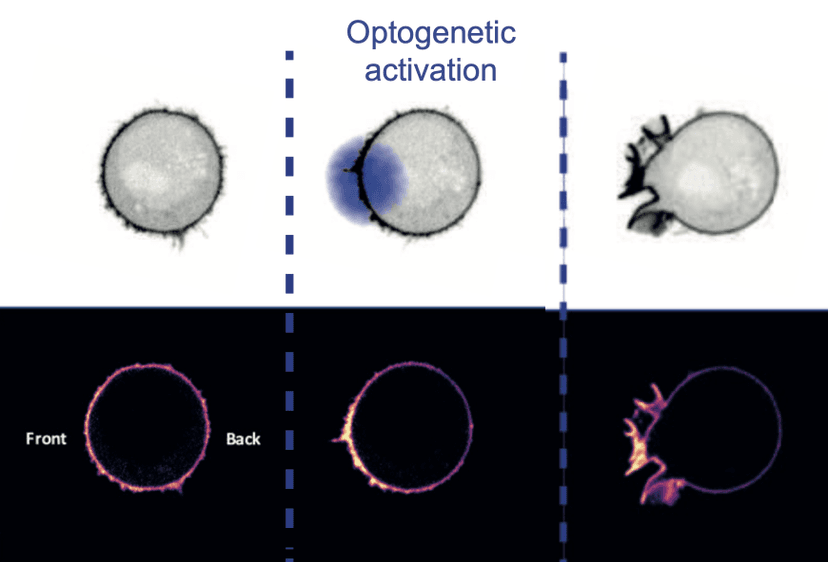
Cell protrusions and contractions generate long-range membrane tension propagation
Highlights
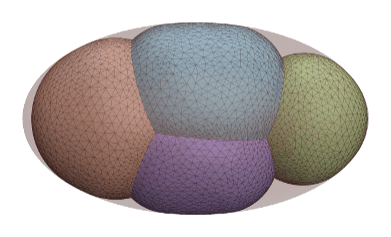
Spatiotemporal mapping of forces sculpting early C. elegans embryos